




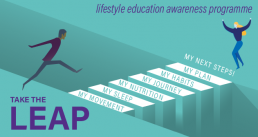
LEAP programme
In 2017 FibroIreland spent 1 year facilitating focus groups with the purpose of designing a self management course for fibromyalgia patients. The course has been co-created to support the patient in tailoring a personalised treatment plan to manage their health.
The course has had many updates on the basis of patient feedback. It is updated twice a year so as to keep up-to-date with developments in managing the condition. The latest update as seen the inclusion of neurodiversity, menopause and long-covid.
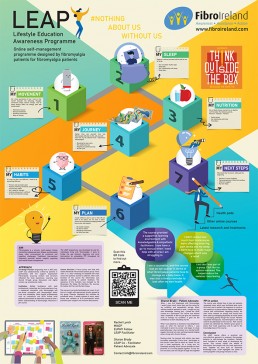
LEAP is a 7 module Lifestyle Education Awareness Programme that we’ve put together to help you get your health on track. It’s not about making big changes, it’s about making small changes and doing them consistently. It will also give you a better understanding of what affects your health and the areas of your life that you may need to look at.
There are 6 core modules and the 7th is to pull all the information together so you finish with your own personalised health plan. The modules take place over zoom. They are 2 hrs in length with plenty of breaks and done every 2 weeks. This is to give you time to absorb information and pace yourself. The programme takes 14 weeks in total. The course is free.
If you want to take part in this life changing programme please email info@fibroireland.com.
Please note this course is only online due to Covid-19
Module 1 – My Movement

Lightbulb Moment
Do I have awareness of how I move in the world? Consider the following… thought, movement, shape, rhythm, change… how do these factors affect my energy, pain and mood levels?
- Introductions
- Brief outline of course
- Mechanical issues
- Manual treatments
- Breathing awareness
- Ways of moving
Module 2 – My Sleep
Lightbulb Moment
Sleep is a natural process and it’s safe for me to let go.
- Understand your circadian rhythm type
- Sleep tips
- Questions to ask yourself about your relationship with sleep
- Sleep diary
Module 3 – My Nutrition
Lightbulb Moment
Are my food choices nourishing me or depleting me? Consider the following words… Remove – Release – Restore
- Eating smart
- Questions to ask myself about my relationship with food
- Food diary
Module 4 – My Journey
Lightbulb Moment
Rather than ask yourself how has fibromyalgia affected my life, ask yourself…
How has my life affected how I experience fibromyalgia?
- Breaking the pain cycle
- The patient journey
- Mapping my patient journey
- My life cycle
Module 5 – My Habits
Lightbulb Moment
If I want my life to be different…I need to do something different
- Understanding primary and secondary pain
- Discovering physical, intellectual, emotional, social and unconscious habits
- Am I ready for change?… Facing challenges and opportunities
- Understanding why it is difficult to start and maintain change
Module 6 – My Plan
Lightbulb Moment
A goal without a plan is just a wish. We all wish to be better, but we have a better chance of successfully managing health if we have a plan and support.
- My Health Mandala
- My plan of action – what to do on a consistent basis
- Managing medications
- My flare care plan – What to do in a flare up
Module 7 – My Next Steps
Lightbulb Moment
What feels like the end is often just the beginning.
- Review of modules
- Personalised plans & fibro flare toolbox
- Aftercare support
- My next steps
Navigating Our Partnership Journey Together
Abstract submission
3rd HSE National Public and Patient Partnership Conference 2025
Authors: Rachel Lynch, Sharon Brady, Northside Fibromyalgia Support Group
Background/Context:
Fibromyalgia is a chronic, multisystem illness marked by widespread pain, fatigue, and disrupted sleep, often accompanied by emotional and cognitive challenges. Traditional interventions frequently overlook patient insights regarding real-world disease management. The LEAP programme—developed and piloted by and for individuals living with fibromyalgia—aims to bridge this gap by embedding PPI throughout its design, delivery, and evaluation.
Methods or Approach:
- Co-Design Process: Originating from a 2017 pilot, LEAP was collaboratively crafted by patients in partnership with the support organisation FibroIreland, ensuring content and structure reflected lived experience. Learning shared through group discussion and digital contact e.g. email/social media.
- Course Structure: A focus group with Dublin Northside FibroIreland patient group was carried out over 3 x 2 hr meetings. This established the main areas that patients wanted to address. After each iteration of the course the information was adjusted and the sequence of the modules was changed to its current format My Movement My Sleep, My Nutrition, My Health Journey, My Habits, My Plan, My Next Step. Groups of 8–10 participants promote peer support and inclusive discussions.
- Facilitation: Skilled facilitators with both professional credentials and lived experience (e.g. a registered counsellor with fibromyalgia and pre-acred counsellor with fibromyalgia) foster trust and relatability.
- Other health professionals such as counsellors and HCPs invited (with patients’ permission) to attend the course to have a better understanding of Fibromyalgia.
Results or Learning:
Participants of the course were invited to co-create the course as modules are updated yearly. Participants informed of their contribution to the course.
The initial course was 6 modules with one module completed per week. Due to patient feedback this evolved into 7 modules with one module being completed every 2 weeks.
The initial course used to be given in one bounded document. After several iterations of the course, participants where given just one module at a time so as not to get distracted by material in later modules.
Patient feedback reported that the course gave them an understanding of the illness and how their daily habits and choices affected their symptoms.
Implications for Future Practice:
We need to develop courses based on the patients’ needs and current abilities.
Provide training for other peer facilitators and have a robust evaluation, supervision system to ensure standards and professionalism.
Course information has been shared at no cost with other patient organisation from an ‘Open source’ perspective. Information needs to be shared rather than having to reinvent the wheel due to information silos.
We need to build on this foundation by co-developing targeted programme adaptations in partnership with underrepresented communities, such as the Traveller community, migrant groups, LGBTQ+ individuals, and people experiencing housing insecurity or long COVID.
- Outline how your Partnership works:
Highlight practical examples of patient / service user partnership in action
The course was initially face to face but patients requested zoom which was facilitated post covid. No travel cost to patient. No exposure to covid as not meeting in a group setting. Participant has better control over environment regarding stimuli. No post travel malaise as energy that would have been used up managing physicality of travel saved for managing getting though the course.
Patient’s requested menopause, neurodivergence and long covid to be addressed on the course. New course content has reflected this.
Patient’s given space to share their lived experience and add to the knowledge base of the course.
Counsellors and HCPs who participated in the course noted that before the course they would not have been aware of the multitude of biological factors driving the illness and would have assumed the patient was just depressed or not trying. The course also gave them food for thought about their own lifestyles and adjustments they needed to make.
Share learnings from projects, programs, or initiatives at all stages
- In planning: All voices included. Suitable location sourced. Handouts emailed to participants to reduce cost of print and postage. Work supervised by clinical supervisor registered with IACP. Participants interviewed before the course to ensure course was suitable intervention and to try and create relatable groups that could share relevant information. Core group of patient partners identified to refine wording and design of the modules at end of each course.
- In progress: After each iteration of the course, it was updated to reflect current participant needs. Participants are informed of the update that they contributed to give them a sense of ownership over the course and encouragement of meaningful engagement.
- Completed: Participants are given the option of staying in touch to form ‘Health pods’. A facilitated meeting is organised at 3 and 6 months after course to see how participant’s are doing and if further support or referral options required.
Explore new approaches to engagement and co-production
Face to Face option would be ideal but would require funding for a venue and 2 facilitators.
Second facilitator took notes which patients stated they found helpful so they didn’t have to worry about taking notes during the course. Patients offered additional support after the module or if they missed the module.
Reflect on challenges, successes, and outcomes of partnership work
Facilitators are working on a volunteer basis so have limited time available.
Participants felt their future was more hopeful and that they had some sort of plan.
No longer have to advertise the course as GP and rheumatology depts now referring people to the course.
Patients reported reduction in medication due to lifestyle changes and greater sense of self agency. Patients further reported reduction in marginalisation and isolation. For some patients it was their first time meeting someone else with fibromyalgia.
Patients able to improve quality of life and reduce pain and fatigue. Or patients able to consider college and/or return to work with knowledge of how to manage the condition and reduce ‘fibro flares.’
Outline collaborations with marginalised, hard to reach and vulnerable groups
The LEAP programme has worked in partnership with national and local patient organisations who have established connections with individuals typically underserved by conventional healthcare and education programmes. These partnerships ensure tailored outreach and support for people with additional needs.
We noticed more patients presenting with neurodivergence and menopausal symptoms so the course was adapted to be neurodivergent friendly and to accommodate menopausal issues such as brain fog. Time blindness and forgetting about appointments can be an issue for both groups. Participants would be given additional support such as a text the day before and or text on morning of the course. Those who needed technical support were assisted with setting up zoom and what’s app.
During iterations of the course where the neurodivergent needs were high, group was contained to 6 to reduce overwhelm. How the course was to be facilitated was very clearly explained and participants were invited to disclose their needs so that we could facilitate additional support.
Facilitators and contributors include individuals from diverse backgrounds who themselves live with fibromyalgia and related chronic conditions. This peer-led model fosters trust, reduces stigma, and helps ensure that group dynamics are sensitive to participants’ varied experiences and needs.
The programme remains open to adapting content and delivery methods in consultation with participants from diverse backgrounds, including ethnic minorities and non-native English speakers. Efforts have included plain-language materials, flexible scheduling, and offering online delivery options to accommodate varied circumstances.
Outreach efforts have included engaging with rural health networks, disability advocacy groups, and social care services to ensure representation from groups such as neurodivergent individuals, people living in rural areas, the long-term unemployed, and those on low incomes or receiving disability supports.